Wednesday, March 15, 2006

(from out of blue) John Stamper!


(excerpt taken from a comment by John Stamper)

I think the key problem for so-called evangelicals (so-called because they are often light years from the early Evangelicals’ very radical understanding of sin and forgiveness, grace and the Law, and especially the bound will) turns on what we mean by REPENTANCE. Because what a lot of times these neo-evangelicals will say is that, on the contrary Paul Zahl, we DO welcome sinners… REPENTANT sinners that is.

Now don’t get me wrong – repentance is an absolutely crucial part of the Christian experience. (C.S. Lewis once said that what modern day people want is “not so much a father in heaven but a grandfather in heaven, a senile benevolence that wants nothing so much as to see young people having a good time.”) Repentance, wrath, sin, accusation, judgement, law – this Christian vocabulary has got to be kept and even SHARPENED, precisely against the accomodating spirit of the age. But I think we need to also turn back to the early Luther and Cranmer, for whom it was so crucial, and hear the language, particularly REPENTANCE, in the way it radically attacked the natural man’s thirst for glory, the way it UP-ENDED “common sense” and “reasonable” theologies.

Common sense and Reason say that we repent of SINS. Plural. Acts. And so repentance becomes a meritorious act of the self-disciplined will, the glorious human will freely choosing (with a little help from some grace) to turn from Bad Actions (or Bad Thoughts, Bad Feelings) and successfully resolving not to do these anymore. We may fall off the wagon later, but the key thing is achieving in the moment that successful self-induced resolution. After all, what could it mean to say you were in a state of repentance WHILE YOU WERE STILL DOING THE BAD THING? That’s crazy… right? It’s folly.

But if we think of the problem as fundamentally a state, not actions springing from a state, and most crucially a state in which we are bound and from which we will not be delivered in this life – if we are not judged by God for what we do, as your dad says, but for who we are – then everything begins to be seen differently. Repentance does very much still involve a 180-degree turning, but not fundamentally one of action – not turning away from bad things that I do, but turning away 180-degrees from belief in myself and turning solely to the Cross, clinging to the Cross alone. Repentance becomes a place of perceiving one’s own wretchedness, a place of true self-awareness and grief and abhorence for what one is, and throwing oneself totally on the mercy of Christ. That is exactly the sense that a drunk can be flushed to the gills, reaching for the bottle and also repentent. Actions may indeed alter later after repentance, but if so that happens via the sanctifying work of the Lord which, along with suffering, always remains a mystery, and His sanctifying work from saved person to saved person differs according the secret counsel of His own good pleasure and in His own time, a Work that CANNOT be used as a litmus test to detect those who have “truly” repented. This is folly to a theologian of glory (who necessarily privileges the Free Will and its capacity to choose its actions) but to a theologian of the Cross, who correctly sees himself in a state of paralysis regarding his ability to choose the Good, it is the only thing that makes sense.

It’s also in this scheme of Luther and Cranmer that we find the radically counterintuitive (but very Biblical and indeed Pauline) idea of forgiveness PRECEDING repentence. Our hearts are hardened – we need an inbreaking Word from without BEFORE we can see as we ought, and love as we ought. Not because we successfully repented first, but because we experience the Word of forgiveness first. THEN we are broken open raw and can admit to what we are. The woman with the oil is broken open by the complete acceptence of her by the man Jesus just as she is, a whore; THAT sovereign action of the electing forgiving Jesus reducing her to wordless grief and tears where all she can do is kiss His feet. (And most crucially, there is no suggestion in the text that she subsequently joins the Young Ladies Christian League and stops plying her trade.) It is the experience of Saul of Tarsus: not because he repented first, but because the bleeding Christ whom he was persecuting loved him and chose him and forgave him; THAT reduces him to wonder and repentence. And this experience becomes a formal part of the Book of Common Prayer: where AFTER receiving absolution we are able to ask for “true repentence.”

So for me what a lot of this turns on is what a modern day evangelical means by Sin (a singular state or plural actions) and therefore what we think God principally cares about. If sin is primarily a plural thing, then we have moralism: God’s primary aim is to improve our behavior (thoughts, feelings). If sin is primarily singular, then God is not primarily concerned with what we do, but with saving us from the Grand Delusion of thinking we can live in any state but utter dependence on Him.

And of course, as Fitz likes to point out, these issues are not primarily intellectual, as if the doctrinal error is a matter of the mind. Hawthorne’s Puritans (no less than the Christians PZ criticizes) are not cruel and prideful to the poor adulteress because they believe the wrong theology; they believe the wrong theology because of the opportunities it gives them to be cruel and proud and self-righteous. “Faith is a rectitude of the heart” as Fitz says.

Tuesday, March 14, 2006

Gerhard Forde quote:


"...The bondage of the will in question is not, for Luther, a matter of force or determinism. No one is forced. It is something more like an addiction. We all do what we want to do! That is precisely our bondage."

recent PZ quote:


"I observe that Christians don't even tolerate sinners, another “other” for all their talk of forgiveness. It is a wondrous fact – an arresting fact – that when Christians fall into sin, the talk one hears literally every Sunday, in principle, of God's forgiveness and welcome to the sinner becomes a dead letter. It is as if we declare "God shows His love for us in that while we were yet sinners, Christ died for us" only to NOT mirror that, any time sin actually strikes close to us in a real live human being. It is an amazing reality that a sinner has about as much chance from Christians as Zontar did from the soldiers in It Conquered the World. (Zontar was burned to death, by the actor Lee Van Cleef.)"

Monday, March 13, 2006

The Peter Principle (by Simeon Zahl)


2/12/03 (by Simeon Zahl)

Peter Talk: What does it mean to live a Christian life?

Today I want to take a look at a character in the Bible about whom I think we tend to have some misconceptions. In any case, the inspiration for this talk came from my realizing I had a misconception about him: the Apostle Peter. Good old Peter, the loyal fisherman. Peter the first head of the Christian church, the first Pope. Probably had a beard. Peter about whom Jesus said “On this rock I will build my church.” And yes, Peter who denied Jesus 3 times. Peter, the great disciple who has been described as “refreshingly human.” Perhaps you have heard a sermon or a talk at some point to the effect of, “See, even Peter screwed up, and royally. It’s ok if you mess up, God loves you anyway.” I definitely have. When I would hear stuff like this, then in my mind I used to make this jump: Peter made some mistakes, but that was all before Jesus died and rose again, before Christianity really started. Afterwards-- after the Holy Spirit came down to the apostles-- Peter preached and healed people and was a generally good guy, and lived happily ever after until his noble martyrdom. After all, he is a saint, is he not? Perhaps this is a picture of Peter that you recognize. Like I said, this picture is definitely the one I had of him until pretty recently: as “the great disciple who was refreshingly human.” I want to take a closer look at this picture of Peter. I want to show that Christians very often (and me specifically) have a misconception about who Peter really is, and about how the Bible really portrays him. I want to try and illuminate the misconception we often have about this important biblical figure and show him as he really is.

Furthermore, I want to show that this subject is more than just a vaguely interesting scriptural quibble. The reason it is more than that, more interesting than that, more relevant than that, is because Peter is the prototypical Christian. It is generally accepted that the apostles are for the most part scriptural “stand-ins” for us. Like us, they are Christians trying to grapple with the trials and joys of the Christian life. I believe that Peter is especially “one of us,” for a simple and obvious reason: he made a lot of mistakes. We know that we tend to screw up a fair bit—morally, academically, spiritually, and so on-- and so we relate especially well to Peter. Do you really relate to John, the “beloved” apostle who never seemed to do anything wrong? He was almost perfect, a true saint. I do not relate to John. I relate to Peter, the guy who denied Jesus because he was afraid of what people would think about him. Peter, who doubted when Jesus told him he could walk on water, and sunk as a result. If you are a Christian, and you feel like sometimes you are not a very good one, then Peter is your man. Peter’s life is as prototypical a Christian life as the Bible gives us. So as we start looking at who Peter really is, as we start trying to clear away our misconceptions about him, we are not just making a small point about Bible interpretation. We are clearing away our own illusions about what a Christian life looks like, about what it means to be a Christian. In Peter we begin to see our own life, naked and honest before God. Have you ever heard the words “What Would Jesus Do?” and thought, “I know exactly what he would do. But I don’t want to do that. It’s too boring, too hard, or too soon.” Well if you have ever felt that way, you probably can relate to Peter. In clearing up the common misconception about Peter, this talk will hopefully make it easier for us to be honest about ourselves—about our own Christian lives-- and therefore will make it easier to be honest with God. Honest with the God who said, “My strength is made perfect in weakness” (2 Corinthians 12:9).
So then, who is Peter? What are we trying to say about him that we do not already know? In answering that question, I am going to focus on three different incidents in Peter’s life:

a) His first meeting with Jesus in John 1,
b) His experience in the garden of Gethsemane as related in Matthew 26,
c) His confrontation with the Apostle Paul, which is described in the second chapter of Paul’s letter to the Galatians.

Each incident gives us a new piece of information about Peter, a new way of looking at him. The total picture that will emerge is one I had never heard until I started studying Peter a few months ago. Ultimately it is a picture of us.
First, let’s take a look at Peter’s meeting with Jesus at the beginning of the gospel of John. Remember, his original name was Simon, not Peter:

[John 1:40-43 “Andrew, Simon Peter’s brother was one of the two who had heard what John [the Baptist] had said, and who had followed Jesus. The first thing Andrew did was to find his brother Simon and tell him, ‘We have found the Messiah’ (that is, the Christ). And he brought [Simon] to Jesus. Jesus looked at him and said, ‘You are Simon son of John. You will be called Peter.’” (emphasis added)]

There are two things that happen here that I think are worth mentioning. First, before Simon says or does anything at all, Jesus renames him “Peter.” In Christianity, as many of you will be able to relate, when we have our first experience of Jesus, we realize that we are being given a whole new identity. Paul talks a lot about “putting off the old self, and putting on the new self.” We are redeemed by God, and as a result we become his servants for the rest of our lives, and we are no longer bound to serve only ourselves. This is what happened to Simon, a fact made abundantly clear by Jesus actually renaming him. For the rest of the book, he is referred to as Simon Peter or just Peter. He is a new man, just like Saul when he was renamed Paul. The other three gospels refer to him as Peter from the very start. They mention that it was Jesus who gave him the name, but they do not describe the incident. So he is Peter, for all intents and purposes, from the moment he meets Jesus until the day he dies.

The second point about this renaming passage from John is that Peter is not just a new name; it is a new name with a meaning. As you may know, the new name comes from the Greek for “Rock.” We learn later on why Jesus names him “the Rock.” Peter is called the Rock because Jesus says to him in Matthew 16:18 “I tell you that you are Peter [i.e. the Rock], and on this rock I will build my church.” Basically, Jesus is saying “buddy, you’re going to be in charge when I’m gone.” We know this is what he meant because after his death, in the book of Acts, the disciples all accept Peter as their leader without any question. They knew beforehand that he was the Rock, the man in charge of the church.

I used to think, “Sure, Peter made a lot of mistakes while he was still learning the ropes, while Jesus was still alive. But things changed after Jesus left and the Holy Spirit came, and Peter became the leader of the Christians, a super-apostle who healed people and preached everywhere, and was generally awesome.” The point is, instead, that Peter was the Rock-- the head of the church and Jesus’ Number 1 Man-- from Day 1, from the moment Jesus met him and changed his name. This means that all the rest of the stuff he did in the gospels—his mistakes, mainly—were done by a full-fledged, prototypical Christian. In a sense, he had already been instated as Pope long before Jesus died. It was the Leader of the Church to whom Jesus said “Get behind me, Satan!” and who didn’t have enough faith to walk on water. For me, this was a new and unsettling insight. I hope that it unsettles you a little bit. Peter was living a prototypical “Christian life” from the minute of his first encounter with Jesus, and the rest of the things he does must therefore be interpreted in this light. We will come back to this point in a moment.

The next passage I want to look at is one that I always sort of skimmed until recently:

[Matthew 26: 36-45: “Then Jesus went with them to a place called Gethsemane, and he said to his disciples, ‘Sit here, while I go yonder and pray.’ And taking with him Peter and the two sons of Zebedee, he began to be sorrowful and troubled. Then he said to them, ‘My soul is very sorrowful, even to death; remain here, and watch with me.’ And going a little farther he fell on his face and prayed, ‘My Father, if it be possible, let this cup pass from me; nevertheless, not as I will but as thou wilt.’ And he came to the disciples and found them sleeping; and he said to Peter, ‘So, you could not watch with me one hour? Watch and pray that you may not enter into temptation; the spirit indeed is willing, but the flesh is weak.’ Again, for a second time, he went away and prayed, ‘My Father, if this cannot pass unless I drink it, thy will be done.’ And again he came and found them sleeping, for their eyes were heavy. So, leaving them again, he went away and prayed for the third time, saying the same words. Then he came to the disciples and said to them, ‘Are you still sleeping and taking your rest? Behold, the hour is at hand, and the Son of man is betrayed into the hands of sinners.’” (emphasis added)]

Let’s unpack this a little bit. Picture this: Jesus tells you to stay awake three times; you promptly fall asleep three times. This is the big night, the night of his arrest. You have been following Jesus day-in, day-out for 3 or so years, and you believe he is the Son of God and the Savior of the World. And you cannot even keep awake when he asks you to. He is sweating blood; you are taking a nap. -- Obviously, Peter and co. are pretty miserable here at doing what Jesus asks them. They do what they want to do, not what he wants them to do…. 3 times. Peter was supposed to be in charge: How do you think he felt? I think he was perfectly aware of what a failure he was proving to be. I bet he felt deeply, deeply ashamed. He must have been asking himself, “Why the heck did he choose me? I’m terrible at this. I have no self-control, and I keep choosing myself over my Lord. How on earth am I supposed to be the Rock on which he will build his church?” This passage to me is just so stark in its opposition between what Jesus wants the disciples to do and what they actually do. Peter and Co. come across so clearly as a bunch of failures. I think this passage often doesn’t get enough attention.

Now I want to put this evening of weakness in Gethsemane in the context of everything else Peter does in the gospels. If you go through an exhaustive concordance looking for every reference to “Simon” and “Peter” in Matthew, Mark, Luke, and John, you will be led to the following events:

a) Peter is afraid and sinks into the water (Matt. 14:27-31).

b) Peter tries to persuade Jesus that he will not have to die, and gets the following reply: “Get behind me, Satan! You are a stumbling block to me; you do not have in mind the things of God but the things of men” (Matt. 16:23, etc.).

c) He denies Jesus three times! (Matt. 26: 69-75, etc.).

d) He draws his sword in Gethsemane and is rebuked for it (John 16:10-11, etc.).

e) He gets rebuked for asking—out of jealousy-- about John, the beloved disciple: “If it is my will that he remain until I come, what is that to you?” (John 21:22).

f) He falls asleep in Gethsemane (Matt. 26:40-46, etc.).

g) He even loses the race to the empty tomb! (John 20:3-4).

In all of this, Peter only does a single good thing: he acknowledges that Jesus is the Christ, the Son of God, and is the first of the disciples to do so (Matt. 16:13-19, etc.). A wonderful, central, important moment, to be sure. But it stands alone in Peter’s gospel story. Otherwise, everything he does in the gospels ends in a correction, a rebuke, or just simple failure. He seems to be pretty useless. This point makes us wonder exactly what kind of a Christian life this is that Peter is leading. Definitely not one of someone who is generally good, but screws up sometimes. Not messing up is the exception. Failure and rebuke is the rule. Are you surprised? I certainly was. It became almost comical going through the concordance references. Like it was a joke. But it is not a joke. Instead, the large-scale ineffectiveness of Peter in terms of his behavior, his actions, points, I believe, to a widespread misconception about who he is, and therefore about how the Bible depicts the Christian life. But before we get to the Heart of the Matter, let’s look at one more relevant passage. At this point, I thought, “Well, maybe Peter is not a very good Christian early on, but he gets better, right? Doesn’t he do all that cool stuff in Acts? Doesn’t it say that people would lay the sick on the side of the road in the hope that even Peter’s shadow would touch them and heal them?” The answer is: Yes, he is used powerfully throughout the book of Acts. But does he really make “progress” as a Christian, in the sense of becoming less prone to failure in Christ’s service? The answer, I believe, is no. To understand why this is the case, it is necessary to look at a passage from Paul’s letter to the Galatians. The context of Paul’s words is this: he is recounting a meeting he had recently had with Peter. Peter, and most of the leaders of the early church, had been persuaded by the arguments of “the circumcision party,” the group who believed that for Gentiles to become Christians, they had to get circumcised and follow certain dietary rules and other precepts of the Jewish faith.

[Galatians 2:11-14: “When Peter came to Antioch, I opposed him to his face, because he was clearly in the wrong. Before certain men came from James, he used to eat with the Gentiles. But when they arrived, he began to draw back and separate himself from the Gentiles because he was afraid of those who belonged to the circumcision group [“party”]. The other Jews joined him in his hypocrisy, so that by their hypocrisy even Barnabas was led astray. When I saw that they were not acting in line with the truth of the gospel, I said to Peter in front of them all, ‘You are a Jew, yet you live like a Gentile and not like a Jew. How is it, then, that you force Gentiles to follow Jewish customs?’”]

Peter was “clearly in the wrong,” had fallen into “hypocrisy,” and was “not acting in line with the truth of the gospel,” for he believed that people had to follow certain laws and rules in order to attain the salvation Christ offers us. He had forgotten that Jesus’ message was for all mankind, and that, thanks to his perfect sacrifice, we are no longer bound to fulfill the Law. And Peter, the Father of the Church and original disciple of Jesus, was publicly rebuked by some upstart who had not even met Jesus before he died, much less been one of his trusted followers and disciples from the beginning. And yet Peter accepted the rebuke and changed his mind on the subject. -- In other words, the Father of the Church had fallen into heresy! He completely misunderstood the entire relationship of Grace and Law that Jesus died to make clear to us; he showed himself to have profoundly misunderstood Jesus’ whole message! I wonder, is there any way he could have screwed up more royally? Not really… Again, let’s think about how he must have felt: humbled, ashamed… Again he must have asked God, “Why me? I’m no good at this. I seem to get everything wrong. You chose the wrong guy for the job.”
So we see, the idea that Peter, despite making a lot of mistakes early on, “improved” and became a “good Christian” does not hold water. Instead, every phase of his Christian life was characterized by a colossal failure or rebuke. It is hard to imagine how to be a WORSE Christian than Peter, short of rejecting the faith entirely, once and for all. The great misconception I alluded to at the beginning is thinking that Peter was basically a good Christian who messed up once or twice. Rather, he could be relied upon to fail at doing God’s bidding, with one or two salient exceptions. And he must have spent much of his life full of shame, guilt, and questions about why God called him in the first place. In the same way, it is a misconception to think that the Christian life is basically successful service to the Lord with a few exceptions. In my experience, I do not seem to be much better than Peter at serving my Lord.
I believe that a lot of Christians question their faith sometimes because they misunderstand what Christian life is meant to be. Just as we misunderstand Peter, so we misunderstand who God expects us, his followers, to be. Like Peter, many of us are full of shame deep down because of our private failures and our private fears. Like Peter, we question whether God would love us and care for us if He really knew what went on, and how we really feel, if He really knew how little we think about Him some days, and how often we choose our own desires over his commands.

Let me be more concrete for a moment: many of us are weighed down by the expectations we perceive others to have about us. These expectations may be in school, in our families, at our jobs; if we are “good” at something, we are expected never to fail at it. At college, most people I know (myself included) struggle with the high academic expectations they feel their parents, their friends, and the world lay on them. People respond to this pressure, these expectations, in two different ways: some feel incredibly guilty about how little work they do, and how last-minute they are, and how much class they miss. They live in fear that people will discover that they are not living up to the potential they were always told they had. They do not think they are meeting the expectations the world has for them, and they feel ashamed, and try to hide their failure. Others deal with the same problem in the opposite way: they feel the same expectations, so they work night-and-day to meet them. This group’s great fear is that they might not do well, and that people will think they are not the successful person they were cracked up to be. Both groups believe they have the world fooled; both are afraid deep down that they might be failures. I think these characteristic ways of dealing with expectations apply to many more situations than just the predicament of the student who feels pressure to excel. All of us have areas where people rely on us, and expect us to come through and succeed. And most of us, to one degree or another, live in fear that the world will realize that we do not meet its expectations, and that we are in bondage to guilt and fear and shame in that area, whatever it may be. And we think, “I shouldn’t be in bondage to this, to these expectations. I’m a Christian, after all. Why won’t God take this problem away from me? Maybe I’m not a good Christian…” And we assume no one else really has the same problem. Like Peter, perhaps, we wonder why God chose us to follow Him if we are so bad at giving up control to Him like we know we are supposed to.
-- Maybe your hidden struggle is a different one: maybe it revolves around some secret sexual sin or bondage. Again, maybe you feel you can’t help yourself—you’ve been struggling against it for years and years with no success-- and deep down you think you must not be a good Christian.
-- Maybe instead your issue has to do with Body Image. You know God loves you the way you are, but sometimes you don’t feel like anyone else will, and you just can’t give it up to God.
Especially with these last two, some of you may have experienced the blinding, paralyzing shame that comes with being “discovered” in your sin, especially by another Christian. It feels like the world is going to end. More importantly, it might make you feel like a failure as a Christian. God doesn’t want us to do these things, to be in bondage to them, and yet we do them, and we feel we cannot help ourselves. Does that mean God doesn’t want us? Are we really failures as Christians?
In order to answer that question, let’s look at what happened to Peter when he was “found out” and forced to face his failures as a follower of Christ. The scene is this: Peter has denied Christ three times—for him probably the worst sin imaginable-- then watched his Lord die. There is starting to be evidence that Christ has been resurrected… but Peter still has the denials on his conscience. Christ meets him on the beach, and the two of them go for a walk, just Jesus and his Number 1 Guy:

[John 21:15-17: “When they had finished eating, Jesus said to Simon Peter, ‘Simon, son of John, do you truly love me more than these?’ ‘Yes, Lord,” he said, ‘you know that I love you.’ Jesus said, ‘Feed my lambs.’ Again, Jesus said, ‘ Simon son of John, do you truly love me?’ He answered, ‘Yes, Lord, you know that I love you.’ Jesus said, ‘Take care of my sheep.’ The third time he said to him, ‘Simon son of John, do you love me?’ Peter was hurt because Jesus asked him the third time, ‘Do you love me?’ He said, ‘Lord, you know all things; you know that I love you.’ Jesus said, ‘Feed my sheep.’”]

This passage is usually interpreted as Jesus’ response to Peter’s 3 denials. Notice first that Jesus calls him “Simon,” not Peter. Perhaps Jesus is using his old, pre-Christian name as a way of acknowledging Peter’s continuing sin. In any case, the upshot of this exchange is essentially that Jesus comes to Peter in all his guilt-stricken pain, and instead of saying, “Sorry man, you blew it, I’ll have to find another Rock,” he says instead, “Not only do I know what you did, and forgive you, but I’m leaving you in charge. Feed my sheep when I’m gone. I’m relying on you.” Jesus’ response to Peter’s most devastating sin is to give him even more responsibility and trust. He gives Peter the opposite of what he deserves. That, my friends, is grace.
So it is with us. God loves us despite our sin. God uses us despite our propensity for failure. And God is not deceived when we hide our shame from the world. His love is so much greater than our failures. He knows we’re going to fail. So his response is to shed his love to the world through our failures and our weakness. We have established that Peter was not good at being a Christian, and that he must have felt terrible about himself most of the time. Does this mean that God couldn’t use Peter? By no means! In spite of everything, “the Rock” had a powerful, thriving ministry, a ministry that is still alive today. In spite of everything, thousands were converted through him. In spite of everything, God carried him through and made his love to shine through him. Jesus’ words became flesh in Simon Peter: “My grace is sufficient for you, for my strength is made perfect in weakness.” And so it is with us.
There are a few things I think we can take from Peter’s story. First of all, Peter’s example is an encouragement to us to be truly honest with God and with each other about the things we are so ashamed about. He already knows when we are not being a “good Christian.” In Peter he shows us that being a “good Christian” is not the point. The point is that God’s grace be made manifest in the world, and he has decided in his wisdom that it is best manifested to us in our brokenness before him. His love is not contingent on anything we do or fail to do. It is so much greater. Secondly, sometimes when we do not want to do something, we say, “I’m not ready yet”, or “One day I will be a good enough Christian to do that, but not yet.” We put off being honest about our sources of shame, thinking that one day these problems will find a solution, but that that day has yet to come. This idea comes out of a misconception about Christian life. No one is ever “Ready” to do God’s will. Peter sure as heck wasn’t. God does not wait for us to be worthy of the responsibilities he gives us; he gives them to us in our weakness. So do not fear failure, or discovery. As Peter learned so profoundly, His strength is made perfect in weakness.

Friday, March 10, 2006

Saturday, March 04, 2006

Charles Mallie quote:


"Some Christians are always looking for some sort of calculus or catchphrase to guide them through each day and help them with all of their decisions. I hear this in my own congregation, "Just give me a Christian principle I can put into practice!" I'm sorry, but life in Christ doesn't work that way. Coke or Pepsi? What would Jesus do? Boxers or briefs? What would Jesus do?...I don't know what Jesus would do, but I do know he wouldn't do it in an SUV! Do you see why this breaks down? The real answer to What would Jesus do? is what Jesus has already done. He died for us. He died to rescue us from the eternal punishment that our sin and rebellion deserves. He died to give us life and life more abundantly. He died to set us free.

"In Christ, we are free from worrying about how our life measures up or whether we are making the right decision about this or that. Christianity is not about us, it is for us. The real answer to 'How do I live a God-pleasing life?' is not about behavior. If you are a Christian, then your life is God-pleasing because God is pleased with the sacrifice of Christ on your behalf, which you wear like a Teflon suit. There is nothing we can do to impress him. Nothing! Remember? His sacrifice is so gracious that even on our worst days -- the days that we seem to make every wrong decision there is -- we can rejoice that Christ died for the whole mess of it. The truth of the Gospel is a radical message of forgiveness that actually saves sinners, eases consciences, and soothes souls. This is a God I would enjoy hearing more about, how about you?"


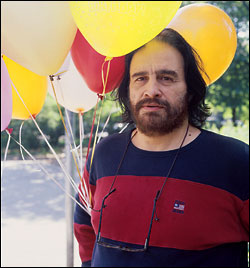
p.s., photo: David Mancuso, current idol of mine. The ballons represent imputed righteousness, despite his very "human"-looking appearance...his "teflon suit".
Thursday, March 02, 2006

David Brooks (for all you Harvard "kids")

Harvard-Bound? Chin Up

By DAVID BROOKS

I've got great news! You're young and you're smart and next year you're beginning college. Unfortunately, I've also got bad news. The only school you got into is Harvard, where, as Peter Beinart of The New Republic notes, students often graduate "without the kind of core knowledge that you'd expect from a good high school student," and required courses can be "a hodgepodge of arbitrary, esoteric classes that cohere into nothing at all."

But don't despair. I've consulted with a bevy of sages, and I've come up with a list. If you do everything on this list, you'll get a great education, no matter what college you attend:

Read Reinhold Niebuhr. Religion is a crucial driving force of this century, and Niebuhr is the wisest guide. As Alan Wolfe of Boston College notes, if everyone read Niebuhr, "The devout would learn that public piety corrupts private faith and that faith must play a prophetic role in society. The atheists would learn that some people who believe in God are really, really smart. All of them would learn that good and evil really do exist — and that it is never as easy as it seems to know which is which. And none of them, so long as they absorbed what they were reading, could believe that the best way to divide opinion is between liberals on the one hand and conservatives on the other."

Read Plato's "Gorgias." As Robert George of Princeton observes, "The explicit point of the dialogue is to demonstrate the superiority of philosophy (the quest for wisdom and truth) to rhetoric (the art of persuasion in the cause of victory). At a deeper level, it teaches that the worldly honors that one may win by being a good speaker ... can all too easily erode one's devotion to truth — a devotion that is critical to our integrity as persons. So rhetorical skills are dangerous, potentially soul-imperiling, gifts." Explains everything you need to know about politics and punditry.

Take a course on ancient Greece. For 2,500 years, educators knew that the core of their mission was to bring students into contact with heroes like Pericles, Socrates and Leonidas. "No habit is so important to acquire," Aristotle wrote, as the ability "to delight in fine characters and noble actions." Alfred North Whitehead agreed, saying, "Moral education is impossible without the habitual vision of greatness."

That core educational principle was abandoned about a generation ago, during a spasm of radical egalitarianism. And once that principle was lost, the entire coherence of higher education was lost with it. So now you've got to find your own ways to learn about history's heroes, the figures who will serve as models to emulate and who will provide you with standards to use to measure your own conduct. Remember, as the British educator Richard Livingstone once wrote, "One is apt to think of moral failure as due to weakness of character: more often it is due to an inadequate ideal."

Learn a foreign language. The biographer Ron Chernow observes, "My impression is that many students have turned into cunning little careerists, jockeying for advancement." To counteract this, he suggests taking "wildly impractical" courses like art history and Elizabethan drama. "They should especially try to master a foreign language as a way to annex another culture and discover unseen sides to themselves. As we have evolved into a matchless global power, we have simply become provincial on an ever larger stage."

Spend a year abroad. Shibley Telhami of the University of Maryland believes that all major universities should require a year abroad: "All evidence suggests this, more than any other, is a transforming experience for students that lasts a lifetime."

Take a course in neuroscience. In the next 50 years, half the explanations you hear for human behavior are going to involve brain structure and function. You've got to know which are serious and which are cockamamie.

Take statistics. Sorry, but you'll find later in life that it's handy to know what a standard deviation is.

Forget about your career for once in your life. This was the core message from everyone I contacted. Raised to be workaholics, students today have developed a "carapace, an enveloping shell that hinders them from seeing the full, rich variety of intellectual and practical opportunities offered by the world," observes Charles Hill of Yale. You've got to burst out of that narrow careerist mentality. Of course, it will be hard when you're surrounded by so many narrow careerist professors building their little subdisciplinary empires.

But you can do it. I have faith.

Tuesday, February 28, 2006

PZ quote re: Contemporary American Evangelical Christian Church mis-guidedness:


Almost every week it seems, I am out in the field, all over the country, and asking how Christianity is faring in whatever region I happen to be in. This is how it stacks up in many places: the mega-churches, almost all of them Pentecostal and offering mostly rock ‘n roll concerts on Sunday mornings, are doing well, but they have tapered off. They are almost all down about 10% or so from a few years ago. The mainline churches are about a third to a quarter full in most places, with some holding their own at 50 to 60% capacity. Our own Episcopal Church is generally failing to attract younger families. This is partly because families with small children are reluctant to entrust their children’s spiritual formation to our denomination, given the current reputation we have. (People usually don’t say this in so many words, but they are voting with their feet; and many old-line Episcopalians are telling me that their grown children are now attending PCA and other conservative churches.)

The other big thing to note is the mall-culture of our life. Everywhere I travel, there are new and bigger malls. I saw one off Route 95 in Florida yesterday, which is a new “destination” mall. It must have been the size of Altoona, Pennsylvania – all stuck in what was very recently a cow pasture. It was Sunday afternoon and the parking lot – more or less in the middle of nowhere – was jampacked, the entry ramps all bumper to bumper. Now these are mostly church-going people, or in that “catchment,” but they are being drawn in vast numbers to new malls everywhere. I think it is fair to say that the biggest competition we are facing, as committed Christians, is the tractor-beam of “shop till you drop.” It is all so empty – an easy target for any serious competitive ideology.

I feel the phrase “empty bromides” provides a clue to the Christian churches’ stalling. For we have stalled, in almost all sectors. Not fallen radically down yet, but stalled.

The preaching in most of these churches, from left to right, is not making contact with the felt needs of people. At least if numbers are any indication. This is because most ministers are speaking from the pulpit as if they are addressing an “in house” group of people who simply need to be motivated to get off their duff and go out there and win disciples. That is not the way to go about it. We need to realize that the people who still come to us Sunday mornings are not a team that needs a cheerleader, but rather a wounded group of sufferers who need to hear the re-animating Word of comfort in God’s Grace and forgiveness.

I noticed this yesterday in a wonderful parish church. I just talked about how it is that people are able to recover from terrible discouragements: They don’t need guilt to motivate them, or cheerleading. They need Love. They need, pure and simple, the strengthening Word that Christ is with them at their point of need. People seemed to line up afterwards. “That was for me”, they said. “You were speaking about my son, my mother, my former spouse…” They don’t need Tony Robbins. They need a Comforter and a Savior.

We are treating congregations as if they are a football squad to be readied for the second half. There is no Balm in Gilead there. No wonder the people who still come are discouraged and so many of our churches are not growing. I almost wonder whether the preachers themselves are in touch with their own need. Can a preacher who tries to exhort his hearers into action really be holding any wisdom about his own problems? We surely are, each of us in public ministry, just sinners and needy weak vessels like everyone else. But that does not seem to be coming through.

“Empty bromides”! And Ferrigno’s book – and note its timeliness in reference to real events that are happening right now, the “cartoons” controversy, which just took 15 lives in Nigeria over the weekend, and the burning of Christian churches, and the dire life-threatening attack on Bishop Ben Kwashi’s family – names it. With the unbeatable pull of the mall (barring a stronger pull from the Rock of Ages, or the Holy Qu’ran, for that matter), Christian churches that offer little of weight and deep comfort to their listeners will go under, slowly. The people won’t come. The people are not coming.

Preachers, dear colleagues, and those who believe in preachers: Look to yourselves, look to your own Achilles heels and your own points of need. Then you can speak with feeling and connection to the enervated selves who are looking up to you, in arithmetically decreasing numbers, on Sunday mornings.

Love,
PZ

Sunday, February 26, 2006

Excellent NY Times article on Redeemer Presbyterian Church (Feb 26, '06):


Preaching the Word and Quoting the Voice

By MICHAEL LUO

In the twilight of the biggest snowstorm in New York City's history, the pews of a rented Baptist church on the Upper West Side of Manhattan were packed for the Rev. Timothy J. Keller's fourth sermon of the day.

The 600 or so who braved the snow for the evening service got what they had come to expect — a compelling discourse by Dr. Keller, this time on Jesus' healing of the paralytic, that quoted such varied sources as C. S. Lewis, The Village Voice and the George MacDonald fairy tale "The Princess and the Goblin." It was the kind of cogent, literary sermon that has helped turn Dr. Keller, a former seminary professor whose only previous pulpit experience was at a small blue-collar church in rural Virginia, into the pastor many call Manhattan's leading evangelist.

Over the last 16 years, Dr. Keller's church, Redeemer Presbyterian, has swelled to 4,400 attendees, mostly young professionals and artists who do not fit the prototypical evangelical mold, spread out across four different services on Sundays. Although Dr. Keller, 55, is hardly a household name among believers outside New York — in part because he has avoided the Christian speaking circuit — his renown is growing in pastoral circles and in the movement to establish or "plant" new churches, a trend among evangelicals these days.

Pastors from around the world are beginning to come in a steady stream to New York City to glean what they can from Dr. Keller and Redeemer. Their goal is to learn how to create similarly effective churches in cosmopolitan cities like New York, which exert outsize influence on the prevailing culture but have traditionally been neglected by evangelicals in favor of the suburbs.

"We're not giving them a turnkey template," said Dr. Keller. "What we're saying is, 'There's lots of overlaps between our big city and your big city. Some of these things you will use. Some of these you will discard. Some of these you will adapt.' "

Believing new churches are the best way to produce new Christians, evangelicals are making a major push to start new churches around the world, said Edmund Gibbs, a professor of church growth at Fuller Theological Seminary outside Los Angeles. But only recently have some evangelicals begun to turn their focus to urban centers.

Dr. Keller "has grasped the strategic significance of the city, of the urban culture and the need to engage that very diverse culture at every level," he said. "Our culture is urban-driven."

In New York City, Redeemer has become the central training ground for anyone planning to start a church in the metropolitan area, whether among Guyanese immigrants in Queens or streetwise youths in the Bronx.

Since 2000, when it established its own training center for "church planters," as they are called in evangelical parlance, Redeemer has helped start more than 50 churches in the city, from faith traditions and denominations as diverse as Assemblies of God, Lutheran and Southern Baptist. In addition, it has helped found 17 "daughter churches" of its own Presbyterian denomination in communities like Williamsburg and Park Slope, Brooklyn; Astoria, Queens; and Hoboken, N.J.

Meanwhile, so-called city-center churches modeled on Redeemer — also attracting audiences of professionals and creative types — have sprung up in places like Boston, Washington, San Francisco, Berlin, London and Amsterdam. The churches emulate much of Redeemer's approach, including its attitude of embracing the city and its focus on the Christian message of grace and redemption, which Dr. Keller argues has been muddled in many churches.

The Rev. Stephen Um, whose church in Boston, Citylife, began four years ago and now attracts about 500 people every Sunday, said he and other pastors had embraced Dr. Keller's emphasis on delving into the prevailing culture almost as much as into the biblical text. Along these lines, Dr. Um is just as likely to cite a postmodern philosopher like Richard Rorty or Michel Foucault in his sermons, as he is, say, Paul's Letter to the Philippians.

"This is Tim's thing," said Dr. Um. "He said, 'You need to enter into a person's worldview, challenge that worldview and retell the story based on the Gospel.' The problem is evangelicals have always started with challenging the worldview. We don't have any credibility."

Redeemer meets in three facilities: the Ethical Culture Society and the First Baptist Church on the Upper West Side, and Hunter College on the Upper East Side.

Unlike most suburban megachurches, much of Redeemer is remarkably traditional — there is no loud rock band or flashy video. What is not traditional is Dr. Keller's skill in speaking the language of his urbane audience. On the day of the snowstorm, Dr. Keller tackled a passage from the Gospel of Mark in which the friends of a paralyzed man carry him to Jesus. At least initially, however, Jesus does not heal the man but offers him a puzzling line about his sins being forgiven.

Part of the point, said Dr. Keller, is people do not realize that their deepest desires often do not match up with their deepest needs.

"We're asking God to get us over that little hump so we can save ourselves," he said. "It doesn't occur to us that we're looking for something besides Jesus to save us."

Observing Dr. Keller's professorial pose on stage, it is easy to understand his appeal. While he hardly shrinks from difficult Christian truths, he sounds different from many of the shrill evangelical voices in the public sphere. "A big part is he preaches on such an intellectual level," said Suzanne Perron, 37, a fashion designer who is one of many who had stopped going to church before she discovered Redeemer several years ago. "You can go to Redeemer and you can not be a Christian and listen to that sermon and be completely engaged."

Dr. Keller shies away from the label evangelical, which is often used to describe theologically conservative Protestant Christians like him, because of the political and fundamentalist connotations that now come with it. He prefers the term orthodox instead, because he believes in the importance of personal conversion or being "born again," and the full authority of the Bible.

An important lesson that Dr. Keller said he had tried to convey to other pastors is that the hard sell rarely works in the city. Becoming a Christian in a place like New York, he said, is more often the product not of one decision but of many little decisions.

"One decision might be Christianity is more relevant than I think," he said. "Or, here's two Christians that I don't think are idiots."

It was the Rev. Terry Gyger, an official with the church-planting arm of the Presbyterian Church in America, an Atlanta-based evangelical denomination, who persuaded Dr. Keller to come to the city to start a church in the late 1980's. At that point, Dr. Keller was a professor at Westminster Theological Seminary and the part-time head of the Presbyterian Church's mercy ministries.

His only previous pastoral experience was at a Presbyterian church in Hopewell, Va., a struggling factory town. Under Dr. Keller, the congregation grew from 90 to roughly 300 in nine years, but that was in the Bible Belt, of course, not New York City.

"I just saw in him the raw ingredients," Mr. Gyger said. "I felt he had the inquisitiveness. He had the intellectual capital. He was very articulate, even though he had not had a lot of preaching experience in the big pulpits of our denomination."

Even so, Dr. Keller was offered the post only after two other candidates turned it down. Within a year of its founding in 1989, however, Redeemer had grown from 50 people to more than 400. By the end of 1992, the church had swelled to more than 1,000 people. Since then, it has continued to grow steadily, all while renting space in several locations.

Sept. 11 proved to be a defining moment for the church. On the Sunday after the terrorist attack, more than 5,000 people showed up. So many people packed the church's Sunday morning service that Dr. Keller called another service on the spot, and 700 people came back to attend. While attendance returned to normal in other churches after several weeks, Redeemer kept attracting about 800 more people a week than it had drawn before the attack.

"For the next five years, I would talk to people about when they joined the church, and they said right after 9/11," Dr. Keller said.

After the attack, the church also began to increase its training for those working to found churches. His church's main goal, Dr. Keller said, is to teach pastors how to truly love the city, rather than fear its worldly influences. Unlike many evangelicals, Dr. Keller advocates an indirect approach to change.

"If you seek power before service, you'll neither get power, nor serve," he said. "If you seek to serve people more than to gain power, you will not only serve people, you will gain influence. That's very much the way Jesus did it."

As a result, one of Redeemer's hallmarks has always been its focus on charity, something it emphasizes in its training of urban pastors. It operates a program called Hope for New York that arranges volunteer opportunities for people from Redeemer with 35 different partner organizations. Last year, 3,300 people from the church volunteered their time.

A looming question for Redeemer, though, is how much of what Dr. Keller and his team have built can be maintained when he ultimately exits the stage. When he was out for several months in the summer of 2002 while undergoing treatment for thyroid cancer, attendance dipped noticeably.

For now, the faithful of Redeemer do not have to contemplate that situation. Dr. Keller continues to preach nearly every Sunday, dashing back and forth to its different rented facilities and putting in unrelenting 80-hour work weeks.

On the night of the snowstorm, Dr. Keller closed his monologue with a moving riff on Jesus' love in spite of humanity's flaws, and a quote from C. S. Lewis, one of his favorite writers: "The hardness of God is kinder than the softness of men, and his compulsion is our liberation."

And then he prayed for his congregation and his city.

Saturday, February 25, 2006

New Mike Fernandez comic (Mike's "interpretation of John Zahl's version of the last supper.")!!!


"This is my interpretation of John Zahl's version of the last supper. You figure out who the apostles should be. Is Blowfly playing Judas? Maybe Don Rickles? Who knows. Nipsey Russell IS Peter. Greenspan should be obvious"...MF

Friday, February 24, 2006

David Bagchi quote:


(taken from his unpublished essay, The function of Luther in the New Perspective on Paul, pp. 3-4. This is a John Camp exclusive!)--

Dunn's second charge against Luther is that he understood 'justification by faith in distinctively individualistic terms', the gospel being for every one 'in his or her own individuality'. In Dunn's view this error has graver consequences than faulty exegeseis alone:

"One might also note its outworking in the individualism and privatization of religion which was such a feature of the political philosophy which dominated the 1980s in the UK".

Warming to his theme, Dunn goes on to include within Luther's legacy not just Margaret Thatcher but also the Third Reich and the apartheid regime in South Africa. There is no mention here of the Enlightenment or political economy; or that Hitler and many of his lieutenants were Roman Catholics, not Lutherans; or that white supremicist Afrikaaners in South Africa were Calvinist, not Lutheran. Clearly, in Dunn's view, Luther has a lot to answer for as a result of his allegedly individualistic understanding of Paul's doctrine of justification by faith.

...Dunn's charge relates not to Luther's understanding of faith but of righteousness.

Dinosaurs and the Bible (John Camp has now officially been hacked!)

I logged into John Camp this morning only to find this post, one which I had never read. It freaked me out, what with getting "violated"/ hacked (out of the blue); It was Lady D! --JAZ


“Most of us loved reading about dinosaurs at some time in our lives. In 1993, the movie “Jurassic Park” stimulated the public interest in dinosaurs far beyond its previous level. As a result, increasing numbers of people have thought, “Since we have found all these fossils and dinosaur bones, we know dinosaurs existed. How come they are not mentioned in the Bible?”

The Bible refers to many the common animals we know today. The list includes lions, wolves, bears, sheep, cattle and dogs along with various kinds of birds, rodents, reptiles, and insects. What is interesting is that this extensive list includes three animals that we no longer recognize. These three are (in the original Hebrew language) tanniyn, b@hemowth (yes, it’s spelled correctly—at least as close as we can get in Roman characters), and livyathan.

Although we alter the spelling of behemoth and Leviathan slightly, we still use those same words in bibles today. However, tanniyn is always translated into another word when we write it in English. Tanniyn occurs 28 times in the Bible and is normally translated “dragon.” It is also translated “serpent,” “sea monster,” “dinosaur,” “great creature,” and “reptile.” Behemoth and Leviathan are relatively specific creatures, perhaps each was a single kind of animal. Tanniyn is a more general term, and it can be thought of as the original version of the word “dinosaur.” The word “dinosaur” was originally coined in 1841, more than three thousand years after the Bible first referred to “Tanniyn.” To make things clearer, we constructed the following table comparing the scientific names with the Biblical names tanniyn, behemoth, and Leviathan.

“Dinosaur” Names, Then and Now
Name and date first written in the Bible
Scientific Name (best estimate) and date the name appeared
tanniyn (dragon)
before 1400 BC
dinosaur
1841 AD
behemoth
before 1400 BC
brachiosaurus
1903 AD
Leviathan
before 1400 BC
kronosaurus
1901 AD

How we got these new names is interesting. In 1822, Mary Ann Mantell became the first person to discover and correctly identify a strange bone as part of a large, unknown reptile. Her husband, Dr. Gideon Mantell, later named this creature an “Iguanodon.” From that time forward, these forgotten animals were given names chosen by the people who rediscovered them. Of course, the Bible, written between approximately 1450 BC and 95 AD, does not include any of these names.

Reading the Bible carefully, you will realize that no living creature matches the descriptions of behemoth and Leviathan. However, if you grab your kid’s dinosaur book, you will notice several possible matches for each one. Let’s examine those.

Behemoth has the following attributes according to Job 40:15-24
• It “eats grass like an ox.”
• It “moves his tail like a cedar.” (In Hebrew, this literally reads, “he lets hang his tail like a cedar.”)
• Its “bones are like beams of bronze,
His ribs like bars of iron.”
• “He is the first of the ways of God.”
• “He lies under the lotus trees,
In a covert of reeds and marsh.”

Some bibles and study bibles will translate the word “behemoth” as “elephant” or “hippopotamus.” Others will put a note at the edge or bottom of the page, stating that behemoth was probably an elephant or a hippopotamus. Although an elephant or hippopotamus can eat grass (or lie in a covert of reeds and marsh), neither an elephant or a hippopotamus has a “tail like a cedar” (that is, a tail like a large, tapered tree trunk). In your kid’s dinosaur book you will find lots of animals that have “tails like a cedar.”

We would expect behemoth to be a large land animal whose bones are like beams of bronze and so forth, so whatever a behemoth is, it is large. A key phrase is “He is the first of the ways of God.” This phrase in the original Hebrew implied that behemoth was the biggest animal created. Although an elephant or a hippopotamus are big, they are less than one-tenth the size of a Brachiosaurus, the largest (complete) dinosaur ever discovered.[1] A Brachiosaurus could therefore easily be described as “the first of the ways of God.”


Comparing all this information to the description in your kid’s dinosaur book, you may come to the conclusion that “behemoth” is not a normal animal, it is a dinosaur—the brachiosaurus. We agree with that conclusion!
Note: Some paleontologists have found fragmentary leg bones, ribs, or vertebrae which they propose belong to “new” sauropods larger than Brachiosaurus. Examples of these include Amphicoelias, Argentinasaurus, Sauroposeidon, Seismosaurus, Supersaurus and Ultrasaurus. There currently is not enough evidence to really determine the size of any of these, and some paleontologists believe that they are merely large examples of known dinosaurs like Brachiosaurus or Diplodocus. In any case, only the “modern scientific name” of behemoth would change. The point would still remain that behemoth refers to a dinosaur, not a “modern animal” like an elephant or hippopotamus.

Leviathan has the following attributes according to Job chapter 41, Psalm 104:25,26 and Isaiah 27:1. This is only a partial listing—just enough to make the point.
• “No one is so fierce that he would dare stir him up.”
• “Who can open the doors of his face, with his terrible teeth all around?”
• “His rows of scales are his pride, shut up tightly as with a seal; one is so near another that no air can come between them; they are joined one to another, they stick together and cannot be parted.”
• “His sneezings flash forth light, and his eyes are like the eyelids of the morning. Out of his mouth go burning lights; sparks of fire shoot out. Smoke goes out of his nostrils, as from a boiling pot and burning rushes. His breath kindles coals, and a flame goes out of his mouth.”
• “Though the sword reaches him, it cannot avail; nor does spear, dart, or javelin. He regards iron as straw, and bronze as rotten wood. The arrow cannot make him flee; slingstones become like stubble to him. Darts are regarded as straw; he laughs at the threat of javelins.”
• “On earth there is nothing like him, which is made without fear.”
• Leviathan “played” in the “great and wide sea” (a paraphrase of Psalm 104 verses 25 and 26—get the exact sense by reading them yourself).
• Leviathan is a “reptile [a] that is in the sea.” (Isaiah 27:1)

[a] Note: The word translated “reptile” here is the Hebrew word tanniyn. This shows that “Leviathan” was also a “tanniyn” (dragon).

Unlike behemoth, who is huge, Leviathan is ferocious and terrifying. Many references (we have not listed them all) refer to the sea, so Leviathan is probably a sea creature. Although some bibles refer to Leviathan as an alligator or crocodile (and both of these are fierce) neither of these is a sea creature. They like the water, but they spend much of their time on land. Further, the question “Who can open the doors of his face. . . .” implies that nobody can open Leviathan’s jaws. Although an alligator's jaws cannot normally be forced open, a punch to their sensitive snout or poke in eye might startle them enough to release their grip.[2] Although this is a good description of an alligator characteristic, it does not fit perfectly with the description of Leviathan, which in the context of the Bible was supposed to describe an essentially impossible event, and we are not done yet.

The description of the scales is interesting. Several verses describe these great scales. Compared to Leviathan’s armor, iron is like straw and arrows ca not make it flee. Let’s face it, an arrow can do a lot of damage to a crocodile or alligator. This is not a description of either of them—or any living animal we are aware of.

And now for the key ingredient: fire. It is hard to read Job 41:18-21 without realizing the Bible is telling us that Leviathan breathes fire. That alone will eliminate almost every living animal. Yes, there is one animal like that in today’s world. It is called a bombardier beetle. This beetle is a native of Central America, and has a nozzle in its hind end that acts like a little flame thrower. It sprays a high-temperature jet of gas (fueled by hydroquinones and hydrogen peroxide with oxidative enzymes) for protection. Now, if a Central American beetle can do it, so could Leviathan. By the way, crocodiles and alligators are out of the picture on this one, don’t you agree?

Before we leave the topic of fire, there are two more notes you may find interesting:
• The history of every culture is filled with stories of fire-breathing dragons. If you think about it, in all the past ages wouldn’t someone have made up a story of a fire-breathing lion or something? Nobody did because the dragon stories are based on truth, and only “dragons” breathed fire. It is easy to imagine Leviathan as a member of the dragon (tanniyn) family. (Plus, Isaiah 27:1 strongly implies this connection.)
• Many fossil dinosaur skulls contain unexplained, empty passages. Scientists have not been able to guess the reason for these passages. Would it make sense that some dinosaurs used these passages as “gas tanks” for the combustible mixture used to “breathe fire?” We believe it does.

Comparing all this information to the description in your kid’s dinosaur book, you may come up with the conclusion that Leviathan is a kronosaurus. We have heard (and read) other suggestions, but the kronosaurus is the best match of any known creature to the description of Leviathan.

Since humans are in the Bible, we unconsciously think that dinosaurs were extinct—and therefore not mentioned in the Bible. As you have just seen, the Bible not only refers to dinosaurs, but has detailed information about two of them.”

Thursday, February 23, 2006

A (sort of) morning meditation:


Here follows the passage (The Parable of the Weeds, also commonly known as the Parable of the Wheat and the Tares) that immediatly came to mind this morning when speaking to a friend about her frustrations with Christian believers who think they can distinguish clearly between who is (and who isn't) "saved". I take this seriously as one who recently, and somewhat rediculoutsly claimed that both Miles Davis and Serge Gainsbourg are now eternal residents of: "H" - "E" - "Double-Hockey-Sticks". Anyway, I offer a few reflections after the text itself. --JAZ

(Matthew 13:24-30)---

24 Jesus told them another parable:

The kingdom of heaven is like a man who sowed good seed in his field. 25 But while everyone was sleeping, his enemy cam and sowed weeds among the wheat, and went away. 26 When the wheat sprouted and formed ears, then the weeds also appeared.
27 The owner's servants came to him and said, 'Sir, didn't you sow good seed in your field? Where then did the weeds come from?'
28 'An enemy did this,' he replied.
The servants asked him, 'Do you want us to go and pull them up?'
29 'No', he aswered, 'because while you are pulling the weeds, you may root up the wheat with them. 30 Let both grow together until the harvest. At that time I will tell the harvesters: First collect the weeds and tie them in bundles to be burned; then gather the wheat and bring it into my barn.'

Some notes on specific verses:

Verse 27: "The owner's servants" (i.e., you and me).
Verse 28b: "The servants asked him (here follows a very human question), 'Do you want us to go and pull them up?' (i.e., "I'll fix it." "Let's get rid of the problem immediately." "I know best," etc.)
Verse 29: This is God's answer to the fallen human tendancy betrayed in the preceding question: "Do you want us to go and pull them up?"..."while you are pulling the weeds, you may root up the wheat with them" (i.e., humans can't see things clearly the way God does, etc. "Plank in your own eye"..."Now we see through a glass darkly"..."Let he who is without sin cast the first stone."...)
Verse 30: "Let both (i.e., good and evil is a real distinction to be made, but...) grow together until the harvest" (i.e., "Don't just do something, sit there!" "Put your sword back in its place." Matt 26:52)

Reflection:

What I love about this parable is not that it points out how incapable we are of discerning the things of God accurately (that part comes as a bit of a blow, if I'm honest, though it's definitely in there!). But I love this teaching because it says that, in light of the fact that I can't distinguish between good and evil (though the two are clearly real and distinct, as illustrated toward the end of this passage), God does the discerning for us; He runs the show, and He's in control (where I know it had better not be left up to me). We are fortunate that God is indeed actually Real and Powerful and able to effect things.

Many Christians wrongly think that God works in the ways they would have Him work. The moment suffering hits, that view is crushed (usually in a very painful way, unfortunately), but that is the point where a real relationship with God through Christ begins. Luther actually says that God blesses us those he loves with suffering (i.e., treats us as he treated his own son). It's important to realize that the Christian message brings human beings to a place where they must confront the thing that they are so deeply afraid of: the limits of their own ability to shape life into that which they desire.

At that point, one starts to view God very differently (i.e., as one who often works through the opposite kinds of ways we would ever envision, through Nazareths, and through weakness rather than strength), and theologians often call this: "A Theology of the Cross", as opposed to the other view, which is sometimes called: "A Theology of Glory". The former is extremely counter-intuitive, and views God as one who intervenes on our behalf. The latter tends to interpret God as working in line with our personal hopes and dreams, and in light of our own wants. The two approaches present very different ideas about the Christian life, grace, and in what it consists. You get the drift. That book you liked called "The Spirituality of the Cross" (G. Vieth) is a layman's approach to explaining this stuff (a Theology of the Cross as opposed
to a Theology of Glory) in accessible terms. I think he does a very good job of presenting the matter. The link below elaborates on the point in a similar fashion, and is helpful.

I write so much about this because it is, for me, the key insight that Christianity brings to the table about human life in a Fallen world, and, further, is the thing that makes Christianity unique. It is the thing that makes Christianity so totally other than "humanism" (which is what I believed in for most of my life); Christianity, in this sense, is "God-ism", or more accurately, "Christ-ism". All of that is contained in this little parable of the weeds. Amazing!

The link below (referred to above) has to do with the exact issue you raised with me this morning in that it discusses the problems that arise when we start thinking we can know and understand clearly where God is and isn't, where he is working and where he isn't working, etc. As the passage from Matthew points out, those lines are far blurrier than most humans are usually willing to admit. At the bottom of the post, you'll see where a friend raised some question about the issue with me, and then how I responded.

Bioluminescently, John Z

Click Me! to read the post referred to in the above paragraph.

New Background at John Camp (thanks in part to the influence of "Lady D") --

I think it has a bit of an Edward-Gorey-meets-Oswald-Chamber's-Bible-Training-College,-Clapham-1912 vibe. Hope you enjoy the new format.

"Lady D"

Tuesday, February 21, 2006

Some of my favorite albums (a list):

Thanks to my short attention span, I usually prefer single songs to albums. When I find a perfect song, I listen to it millions of times, until I find a new perfect song, etc. But I do think there are some amazing full albums out there. Here are the ones that come to mind (note: I will add to this list as regularly as the memory is jogged)":


Gary Wilson: You Think You Really Know Me (Recorded and performed in Endicott, NY in a basement. Way ahead of its time! A notoriously worth-it cult album. I saw this guy live, which involved his wearing lady's underpants on his head, a mannequin strapped to his back, and his band mates throwing baking flower at him while he writhed on the floor moaning the names of girls from his 7th Grade home room. Beck gives a shout out to this guy on "Where it's at." After this album re-emerged to lots of critical acclaim, Gary was finally tracked down working in an adult book store in San Diego, playing gigs with a house band at the local Radisson Inn. He had not had a phone for over 8 years. He made a new album last year on Stones Throw which flopped, but was pretty cool. There's even a documentary and another excellent album of old out-takes and unreleased stuff. I first heard him when the only way to get his album was to befriend one of the employees at Other Music, and get them to make a tape for you...)

Deltron 3030: 3030 (One of the smartest hip-hop albums ever made. Pre-Gorillaz, but all the seeds for that project are sown here. The opening track is epic with Kid Koala scratching wonderfully, but the whole thing is great! The premise of the album is that it was made in the future, in the year 3030, and they use the future as an interesting lens through which they are able to criticize the present. My favorite line: "Never let a computer tell me shit!" Del at his best. Dan the Automator at his best, mostly. Damon A, from Blur, narrates, and MC Paul Barman makes a hilarious guest appearance. Though there are stand-out tracks -- "Thing you can do", "City Madness" -- the sum is greater than its parts. )

Polyrock: Polyrock (Phillip Glass produced. Perfect, tight NYC punk song-writing and edge, but with beautiful authentic synth keys added. If you like the Strokes, this is your band!)

Can: Ege Bamyasi (From their excellent Damo Sazuki period. Every song on this rocks, though I wish it had more electronic experimentation, which is the stuff that make later Can so significant. I think this album is far superior, and less 70s-bound than the more popular Tago Mago. These guys are German, with a Japanese lead singer. The moment you start to turn into a Music Indie Nerd, Can immediately surface. Jaki Liebezeit's drumming is incredible. I've recently discovered the most amazing song from a side project by Holger Czukay, Can's bassist, and Jaki, their famous-for-a-reason drummer, made with Jah Wobble. Find this song: "How Much Are They?"! Another really cool Can tune is a later one, called: "I Want More". It's a gem!)

Gary Numan: The Pleasure Principle/Replicas (I love both of these albums, and keep coming back to them year after year. The keys and the real instrumentation, the overt conceptual-ness, the whole alien in the 80s thing. This music is timelessly cool. If you're having a party and want to impress, but aren't sure where to go with the music, just put this on, and use red lighting. You can't go wrong. Also, the cover of Pleasure principle is great.)

Dudley Perkins: A Lil Light (Madlib beats, Dudley Perkins vocals. Not really rap, or soul, or any genre per se. This album got panned, but I always go back to it. It's just one of my faves and Dudley is Christian. I also really dig his rapping under the alias Declaime. For more, see the post I put up about him in November.)

Quasimoto: The Unseen (Probably my favorite hip-hop album of all-time. Really raw and out-there, but all the seeds of what would later become Madlib's immense influence are present here. The main attraction is the loose, apathetic quality of the production and Quasimoto's helium voice, which is just Madlib's sped up. The lyrical content won't overwhelm, so don't go here for that. Personally I'm glad this guy steers clear of attempts at profundity. Check out the song "Come on Feet", which is a cover of sorts, and is one of the weirdest hip-hop singles ever released. You can see the video on Stonesthrow.com. There aren't really any particularly note-worthy stand-outs as this is really a sort of home-grown, cannibus-smoking producer's science project, but "Bad Character" is a good place to start. "I'll have you slavin' in my dungeon while I'm eatin' swordfish!")

The Flame: The Flame (Sometimes called "The Black Beatles". This album sounds just like the White Album. The song-writing is trite, but catchy as all-get-out. Amazingly, one of these guys later became a member of the Beach Boys. Typical weird Beach Boys fact. They are from South America, I mean, S. Africa.)

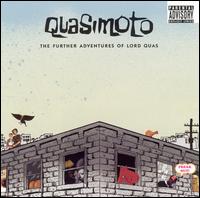
Quasimoto: The Further Adventures of Lord Quas (The recent follow-up to "The Unseen". Excellent again, mainly as a whole. I just love listening to this stuff. Madlib is a true artist, and, fortunately, prolific as well. Jay Dee was really the only current cat who could hang with this guy's vision. I also love Madlib's tribute to the late Weldon Irvine, under the alias, Monk Hughes, but it's not exactly radio music. Think Miles Davis' "On the Corner".)

Cannibal Ox: The Cold Vein (Another of my favorite hip-hop albums. This is El-P's production at its best. This is Def Jux when Def Jux was new and interesting. Vast Aire shreds from start to finish. Every song is excellent. I can't pick a favorite. This is dense music, made for multiple listens if any at all. It will keep your basket full of fish, and your other basket full of orchard fruit; a very high careful-listening-bears-fruit ratio. "You were a still-born baby; your mother didn't want you, but you were still born." One last comment on this: this album has views the world to be truly Fallen. The album is entitled "The Cold Vein", like the vein of the reality of stuggle that runs throughout life. At one point, the throw-away, "New York is evil at its core" is stated, which is a statement I've never been able to shake. Seriously. Are you wondering if they end the album talking about the need for Holy Spirit intervention? "Scream Phoenix" is a song loaded with theological implications.)

Madvillain: Madvillainy (In my top 5 of all time. I would choose this as a desert island disc. Just buy it and then try to figure it out. MF Doom is my favorite rapper and this is the only project of his that I'm listing, but, know that, almost every morning, my computer wakes me up with a song from his catalogue chosen at random. I have everything he's ever recorded, I think, which is like 30 albums. Everything he says is brilliantly witty, and thought provoking. He was born in England and his story is fascinating. His lyrics just keep on giving and fortunately much of his production is top notch as well. But the production aspect reaches its peak here with Madlib. Check out "All Caps", "Great Day", "Meat Grinder" for starters.)

A Certain Ratio: Early (This band is my current obsession. Art-punk-disco from Manchester's New Wave scene.)

Vitesse: You Win Again, Gravity (I love this band, almost every single song. I used to find a new "favorite song" every day. Think Psychedelic Furs, Talk Talk, Stephin Merritt w/out the irony, layers, wonderful production, stangely complex melodies. This is an album that keeps on giving. The initial stand-out is "Unsolvable" or "Ride the Hook", but my faves are "Out Under Stars" and "In Time". I also love the fact that noone seems to have heard of them. I've always felt like they were my own personal favorite band, just for me to know about.)

Serge Gainsbourg: L'Histoire De Melody Nelson (This one makes a lot of lists. The band sound a bit like Neil Young's band on the Cowgirl in the Sand/Down By the River jams of his early days, but with the edition of the New College boys choir. This album is truly Humbert Humbert singing to and with Lolita. You don't have to know French to understand perfectly. But it's incredibly haunting and rich as well. Serge is another whole world to be explored. The best stuff is the stuff with Jane Birkin, though the later "Lemon Incest" phase with his daughter is a personal fave. This guy is basically Tom Waites meets Elvis meet Jarvis Cocker all rolled up in a frog, though I wonder seriously if there is anything actually redemptive to be found in his story. Serge Gainsbourg, like Miles Davis, is probably spending eternity in Hell.)

Dennis Wilson: Bamboo (This is the secret Smile-like project of my favorite Beach Boy. This is hard music to track down, but well worth it, if you don't mind sentimentality, which I obviously do not. See my earlier post on Dennis for more. He is in Heaven, I feel confident. "I know a carpenter who had a dream. Killed the man, but you couldn't kill the dream. He said, 'People gotta be free!'")

Miles Davis: The Cellar Door (Box Set) (I've recently found myself returning to Miles' electric period, the music with which I was obsessed in high school. This recent release captures the best of that period and I love it! The perfect degree of improvised abstraction, funk and Retro-cool. Keith Jarrett's keys on this stuff are as sick as anything ever recorded. And Jack D is no slouch. If they come out with a time machine, I'm going to go back and attend every one of these concerts!)

Fourtet: Madvillainy (Fourtet Remixes) (Great, very abstract remixes of some of my favorite songs. The place where authentic synth instrumentation meets rapping at its most sublime is the place where I want to grow old. I think Fourtet may have a map.)

Koushik: One In a Day (I love this guy's ear and leanings. This EP is the most consistent display of those sensibilities. Think raw, urban, dj/hip-hop beat production combined with 60s-style harmonious melody based song-writing. Very beautiful and ethereal, but with its tail dragging in the gutter. His full-length comes out in the Fall, and I'm sure it will be on this list the next day.)

Souls of Mischief: 93 'til Infinity (The album that got me back into hip-hop in 1994, after a 7 year hiatus. The rapping is ahead of its time, and the beats are great. I love their on-the-mic personalities. Urban artistic leanings, like Mobb Deep, without any of the education to make it mainly a release that targets the white man. A sort of Quannum/J5 that just couldn't cross over and got caught somewhere in the too creative to sell, too legit for college students category. There subsequent releases have proven dissappointing. "A Name I Call Myself" is the best hip-hop song of a totally lude nature ever!)

Cristina: Sleep It Off (Think WASP, think Lower East Side punk, think 70s disco, think 80s synth, think British aristocracy, think cynicism directed at hip hedonism, Think Harvard, think Radcliff, think anomalous Marriage right out of college in NYC, plus guitars and keys, and compass point instrumentation/studio stories, plus great photography of Cristina, who is attractive to say the least, wearing a Red leather slicker in an Upper East Side town house, with not one but two minks on rhinestone-encrusted leashes, etc. The best song about Christmas as well!)

Bertrand Burgalat: The Sssound of Mmmusic (My favorite French producer's first solo effort. He played bass for Air on their first US tour and epitomizes all that is good about 60s French Camp production, and a heavy dose of conceptual weirdness. I saw this guy live at the Mercury Lounge 4 years ago in his single US performance and it rocked!)

Blackalicious: Melodica (Their first EP from 93, and also DJ Shadow's first released piece of music, "Swan Lake". The rapping is tremendous, and unstoppably intelligent, and creative but without any of Gab's later New Agey musings. This is dope as ...heck! Not too artsy. Each of the 7 songs are perfect! A favorite ever since I first heard it. Notice Lyrics Born on "Deep in the Jungle". He gets really weird: "I know you can make colors rhyme...")

Mobb Deep: The Infamous (The reality of art spawned in adversity, like the Greece's Golden Age. This album holds up like the day it was released. Their straight-forward descriptions of project-life bring on goose bumps. There's real poetry, and amazing expression going on here! This one kept Nas's first off the list, though I love that too. This is the better version of that.)

Various Artist: The Trip (created by St. Etienne) (Great selection of obscure gems from the 60s and 70s.)

The Ethiopians: Engine 54 (I've been going back to this album regularly since 1997. I love male falsetto singing, and this is that at it's most beautiful. It's called Ska, but technically it's actually of the Rocksteady genre, which I much prefer. Pre-Selasi reggae oozes Christianity, and lacks a certain anger that permeates the scene when Rasta stuff enters the scene. These guys sing like they're all virgins. Check out: "You've got the Dough, but I've got the Soul" or the title track, for starters. The album has about 6 perfect songs and the rest are just fine. The title track is a bit weird as well, and it sounds like they're singing "Angel 54" not "Engine 54" and I like the idea of numbered angels in a kind of Middle Ages sort of a way.)

Burning Spear: Marcus Garvey/Ghost of Marcus Garvey (This is haunting stuff. The dub versions are cool. His voice is like that of a prophets crying blood. I saw Burning Spear live in Cleaveland once. It was not the "happy-Jah-love" reggae vibe that one might have expected. Burning Spear didn't start playing until well after 1am. The event was in a biker bar and there were fist fights breaking out between bikers, hippies, and rastas. Pretty dark and brooding. Check out: "Live Good" for the most instantly accessible track.)

Digable Planets: Blowout Comb (This was big for me in high school. It represent everything that I thought was cool re: retro, black culture, the 70s, etc. The album hold up, mainly because its production is so sophisticated, but also because Butterfly raps beautifully. "Sub zero degrees can't freeze the cool breeze." Unfortunately, this stuff has turned out to be much less cool that I originally realized. But check out the opening track, or track 5, or the final one with its great beat, gorgeous brass, and easy pacing. I still love it! Doodlebug has not held up though. His rapping is...not so great.)

Al Green: Call Me
Mouse on Mars: Niun Ngung
Tarwater: Silur

Raz Ohara: The Last Legend (This album saw me through a very painful break-up, and also precipitated my re-conversion to a more devout Christian life. This is a Dutch guy who sings like Prince, but does simple R & B ballads, mostly with just the backing of a guitar. The track "Reality" posits that, on the other side of heart-break, there is a quasi-mystical experience called "reality" to be found. Such was indeed true for me. I was so prickly at the time, like "Don't touch me", and this was all I could stand to listen to. "Give me back my bike.")

Toshack Highway: Toshack Highway

My Bloody Valentine: Isn't Anything (For me, this album is high school. I'm so pleased it's held up so well over the years, though the drumming weaker than most are willing to admit. I've listened to this more than probaly any other piece of music. I love "Blown a Wish" and I was in a band in college that covered "Only Shallow" not very well, but nonetheless.)

Pixies: Surfer Rosa
Slum Village: Fantastic, Vol. 2
Madlib: Remixes 2
Lenny Breau: 5 O'clock Bells
Japan: Gentlemen Take Polaroids/Adolescent Sex/Tin Drum
The Zombies: Odessey & Oracle
Pulp: This is Hardcore
Phoenix: Alphabetical
Stephin Merritt: Pieces of April (soundtrack)
Pat Martino: Baiyini
Twin Peaks (the movie): Fire Walk With Me (Soundtrack)
Jaylib vs. J-Rocc: Championship Sound (Bonus Disc)
The Feelies: Crazy Rythms
The B-52's: Mesopotamia
Jan Hammer: Complete Miami Vice Instrumentals
The Magnetic Fields: 69 Love Songs
Lovage / Dan the Automator: Music to Make Love to Your Old Lady By
Ladytron: Light & Magic
Kid Koala: Carpel Tunnel Syndrome
Giorgio Moroder: From Here to Eternity
Nino Nardini & Roger Roger: Jungle Obsession
Duran Duran: Rio
Fleetwood Mac: Tusk (Bonus Disk)
Cody Chestnutt: Headphone Masterpiece
John Coltrane: Ole
Sam Prekop: Sam Prekop
Olivia Tremor Control: Black Foliage
Breeders: Pod
Boby Dylan: John Wesley Harding
Ann Peebles: The Hi Years
Blonde Redhead: Ballad of Certain Damaged Lemons
Arthur Russell: Calling Out of Context
Ghostface Killah: The Pretty Toney Album/Bulletproof Wallets
GZA: Liquid Swords
Zoot Woman: Living in a Magazine
Daft Punk: Discovery
DJ Vadim: USSR Reconstruction
Apples in Stereo: Her Wallpaper Reverie
The Slits: Cut
Cecil Taylor: Looking Ahead
Tom Tom Club: Tom Tom Club
Bobby Brown: The Enlightening Beam of Axonda
Beach Boys: Friends/20-20
Company Flow: Funcrusherplus
Juggaknots: Clear Blue Skies
RJD2: Since We Last Spoke/Dead Ringer
Roxy Music: Siren/Roxy Music/Flesh & Blood/For Your Pleasure
Whitey: The Light At the End of the Tunnel is a Train

Click Me! for the best album list I've found on Amazon

Sunday, February 19, 2006

Great Album Cover (good, not great, album):


plus, here's a link to an informative interview with Koushik: Koushik Interview (Click Me!)

a quote from that interview: "As far as current stuff, the only people that I constantly get really excited about are Dilla, Madlib and Doom. I'm sure there's lots of people doing great things; I just haven't heard much of it."

Saturday, February 18, 2006

Ernst Kasemann quotes:


taken from "The Testament of Jesus" --

“’The Light shines in the darkness’…This encounter reveals the world’s whole past, present and future as darkness, in so far as it does not enter into and remain in the brilliant stream of light. The Gospel, therefore, describes the world as the realm of deficiancies and defects, of sickness and death, of lies, unbelief and misunderstanding, of doubts and sheer malice.” (p. 34)

Friday, February 17, 2006

Toilet Stall Graffiti from the Radcliffe Camera


For some time, I have been wanting to post a comprehensive guide to the Bathroom Grafitti found in Oxford's famous Radcliffe Camera. Unfortunately, those in charge monitor the situation carefully, cleaning and repainting the walls with amazing regularity (i.e., think Switzerland). But today, like a gift, I found the following hilariously theological piece of vandalism:

"READ KARL RAHNER!"